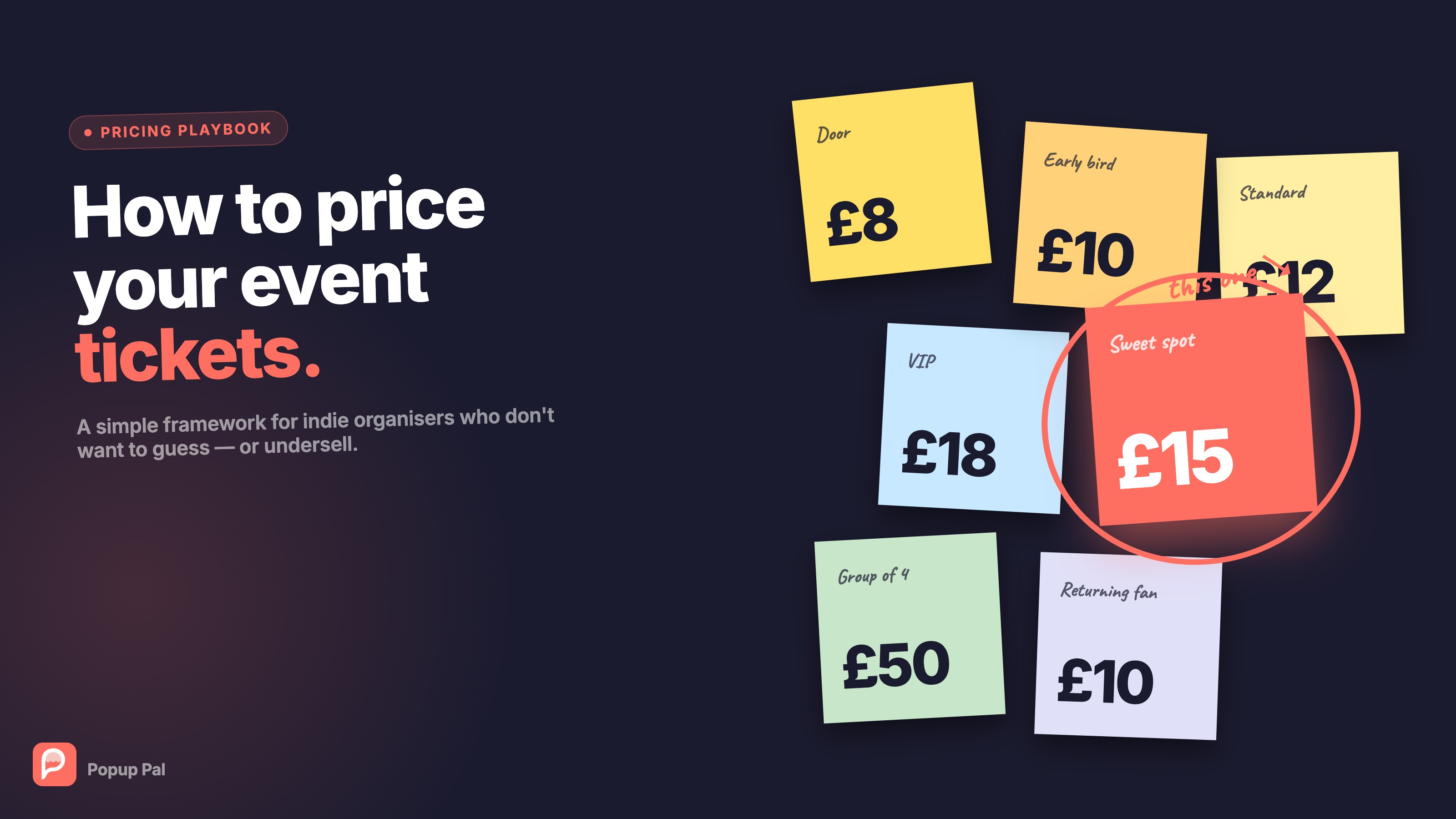
Pricing tickets is one of the harder calls for independent organisers. Price too high and the room sits half empty. Price too low and you cannot cover your costs, or you devalue the experience you have spent weeks building.
There is no formula that works for every event. There is a practical framework. This guide walks through how to think about ticket pricing, from calculating costs to using tiered strategies that protect both attendance and revenue.
Start with your costs
Every pricing decision begins with knowing what you are spending. Too many first-time organisers set a price on instinct, then find after the event that they barely broke even.
Fixed costs
The costs you pay regardless of how many people come.
- Venue hire. Usually the largest line.
- Equipment. Sound, lighting, projector, tables, stalls.
- Insurance. Public liability, often required by the venue.
- Licences. PPL/PRS music licence, alcohol licence, temporary event notice.
- Marketing materials. Flyers, signage, banners (if any).
Variable costs
The costs that scale with attendance.
- Catering. Per-head food and drink.
- Staffing. Security, bar staff, cleaners, door staff.
- Ticketing platform fees. These vary significantly by platform.
The break-even calculation
A simple formula.
Break-even price = (Fixed costs + Variable costs) / Expected attendance
Take a 200-person event.
- Venue: £800
- Sound and lighting: £300
- Insurance: £100
- Staff: £400
- Miscellaneous: £200
- Total: £1,800
Divide by 200 attendees and the break-even price is £9 per ticket.
You should not sell at break-even. You need a margin for unexpected costs, for reinvesting in the next event, and because your time has value too. Add 25 to 30% and you are looking at a ticket price of around £11 to £12.
Research what similar events charge
Your break-even price tells you the floor. The market tells you the ceiling.
Look at comparable events in your area. Same type, similar capacity, similar audience. Check ticket prices on Eventbrite, FIXR, Skiddle, or wherever they sell. That gives you a realistic range.
If your cost-based price is significantly higher than the market, you have two options.
- Cut costs. Cheaper venue, fewer staff, simpler production.
- Add value. Better lineup, exclusive experiences, premium touches that justify the price.
If your cost-based price is well below the market, you are probably undercharging. Do not leave money on the table.
Pricing psychology: the small things that matter
The difference between a ticket that sells and one that sits unsold is not always the price. Often it is how the price feels.
The £9.99 effect
Charm pricing works. £9.99 reads as meaningfully cheaper than £10, even though the difference is one penny. Well-studied consumer psychology, and it applies to event tickets as much as to retail.
For tickets in the £10 to £30 range, pricing at £9.99, £14.99, or £19.99 can lift conversion without meaningfully affecting revenue.
Round numbers for premium events
There is one exception. If you are positioning the event as premium or exclusive, round numbers (£25, £50, £100) signal quality and confidence. Charm pricing reads as cheap in a premium context.
The anchor effect
If you offer multiple tiers, the highest-priced tier makes the others read as better value, even if very few people buy it. This is anchoring.
A VIP ticket at £40 makes a standard ticket at £15 read as a bargain. Even if 5% of buyers take the VIP, its presence raises the perceived value of the standard tier.
Tiered pricing strategies
Flat pricing, one ticket at one price, is the simplest approach. Tiered pricing gives you more flexibility and can lift both total revenue and early sales momentum.
Early bird pricing
Early bird discounts reward people who commit early. They create urgency, generate early cash flow, and give you a demand signal well before the event.
A typical structure.
- Super early bird. 30 to 40% off, capped at the first 10% of tickets.
- Early bird. 15 to 25% off, capped at the first 25% of tickets.
- General release. Your standard price.
The key is genuine scarcity. If your early bird tier never sells out, it is not creating urgency. It is a permanent discount. Set a real cap and stick to it.
Time-limited or quantity-limited
You can cap early bird tickets by quantity ("first 50") or by date ("until 1st March"). Quantity limits tend to create more urgency because they feel less predictable. Date limits are easier to communicate in marketing copy.
Group discounts
Group discounts encourage people to bring friends, which lifts attendance and creates a better atmosphere.
A common approach.
- Buy 4+, get 10% off
- Buy 8+, get 15% off
This works particularly well for social events, comedy nights, food festivals, markets, where people naturally come in groups. Discount per ticket is small, total spend per transaction is much higher.
Promo codes
Promo codes let you offer targeted discounts without changing your public pricing. Useful for:
- Partnerships. Give a local business or creator a code to share with their audience.
- Returning fans. Reward people who have been to previous events.
- Last-minute sales. If tickets are slow, a limited code creates urgency without publicly cutting the price.
The important thing is to track which codes drive sales. Most ticketing platforms show which codes were used and how many tickets each one sold.
Donation-based tickets
For charity events, community fundraisers, or pay-what-you-feel experiences, donation-based tickets let fans choose their own price above a minimum. This can lift revenue, people often pay more than you would have charged, while keeping the event inclusive.
How platform fees affect what you keep
Many first-time organisers overlook this. Your ticketing platform's fees directly affect how much you keep on every ticket sold. The differences are larger than they look.
On a £10 ticket.
| Platform | Fee | What you keep |
|---|---|---|
| Eventbrite | £1.29 | £8.71 |
| Skiddle | £1.25 | £8.75 |
| Fatsoma | £1.00 | £9.00 |
| FIXR | ~£0.89 | ~£9.11 |
| Ticket Tailor | ~£0.80 | ~£9.20 |
| Popup Pal | See pricing | – |
The spread between the most and least expensive percentage-based options is meaningful. Across 300 tickets, the difference adds up to enough to upgrade your sound hire, pay an extra steward, or simply keep as profit.
When you set your ticket price, factor the platform fee in. If you absorb it rather than passing it to the buyer, your real revenue per ticket is lower than the listed price.
Pass fees to the buyer or absorb them
Both approaches are valid.
- Absorb. The price on the listing is the price the buyer pays. Cleaner, you receive less per ticket.
- Pass to buyer. The buyer pays the listed price plus a booking fee at checkout. You receive the full listed price, total cost is higher for the fan.
Most platforms default to passing fees to the buyer. If you compete in a busy market, absorbing fees can make your listing read cheaper, which helps with conversions.
Pricing free events
If your event is free, you might think pricing strategy does not apply. Free events still benefit from ticketed registration.
- You know how many people to expect.
- You can communicate with attendees before the event.
- You build a fan list for future events.
- You read more professional than "just turn up".
Some free events offer optional donations or paid extras (VIP areas, food bundles, merchandise). Those generate meaningful revenue without putting a barrier on general entry.
Review and adjust
Your first event's pricing is a best guess. Your second should be better informed.
After every event, review.
- How quickly did tickets sell? Sold out weeks early, you probably underpriced.
- How many no-shows? High no-show rates on cheap tickets suggest the price was low enough that people did not feel committed.
- What did fans say? "Great value" is nice. It can also mean you could charge more.
- What were your actual costs? Compare to your estimates and adjust for next time.
Pricing is a skill that develops with each event. The most important thing is to start with the data, make a deliberate choice, and learn from the result.
Built for every event. Designed for every organiser.
Tiered pricing, early bird windows, group discounts, promo codes, and donation tickets, built in. Plus active marketing as standard. See what your event would look like on Popup Pal.
Create your event